Almost anyone I talk to about my future career, they often ask me these two questions. Why do you want to become a pilot / what made you choose this career? Which airline do you want to work for? In today’s blog, I will be sharing my answers to these two questions.
Why do you want to become a pilot?
I am currently studying to become an airline pilot so my specific program is called the restricted Airline Transport Pilot/ Certified Training Program (R-ATP/CTP). What this means is that once I graduate with all my hours and my Bachelor’s degree of aeronautical science, I have some options of working either as a commercial pilot, flight instructor or an airline pilot. Who knows what my future will look like especially with the pandemic situation, but my ultimate goal is to become an airline pilot.
When I was a child, I loved cars and animals. I had boxes full of toy cars and everyone around me knew that I was always surrounded by cars. As I entered middle school, my interest shifted towards airplanes and helicopters. I often drew sketches of military jets and helicopters and I also collected miniature airplane models. However, aside from these hobbies, I didn’t have a any close family member who was in the Air Force or the airlines that I grew up looking up to. My only exposure to flying in general was the experience I had traveling abroad with my family.
During high school, we had college representatives visit our school once a year to promote and guide students in their college application process. One day, a college rep was standing in the lobby of my school with a campus map of a university that was placed right next to a runway. At first, I thought that map was the coolest thing since the rep also had small plane models sitting on the table. Her name was Terra (who is the international recruiter for ERAU Daytona Beach) and that’s when my story with Embry-Riddle began. Long story short, I got accepted to Embry-Riddle and I started attending this university from 2017. After spending almost four years at Riddle now, I am still fully committed to the future career of flying.
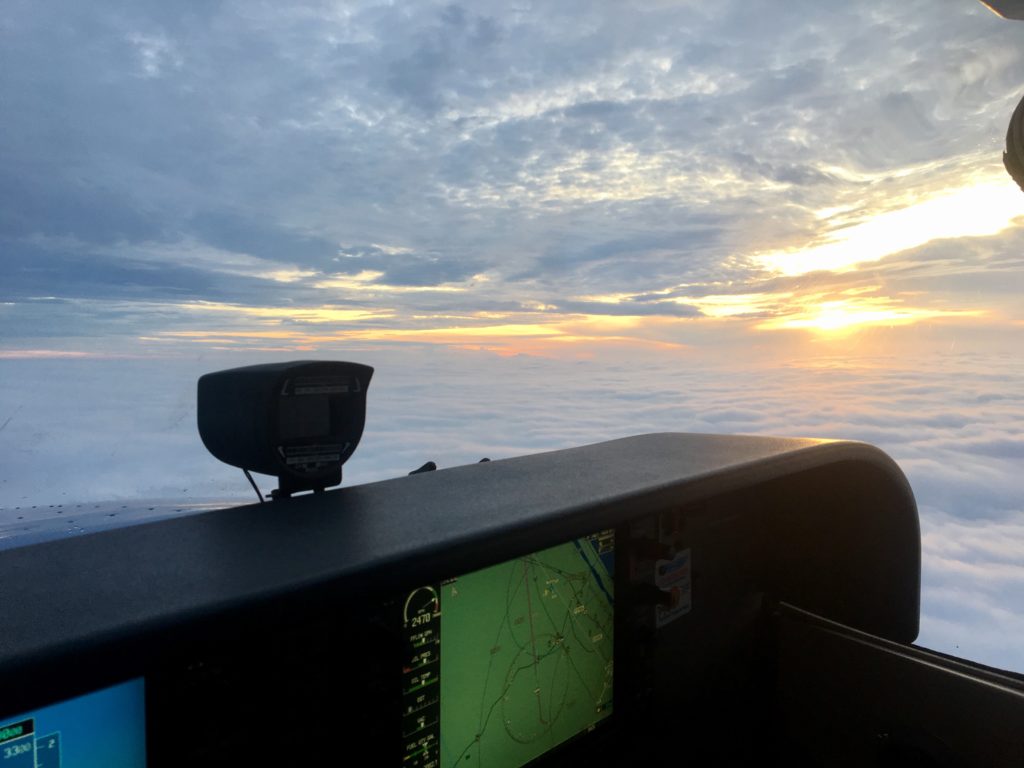
My first flight in a small single-engine aircraft came a few days after my first day of class. The university really got us into these planes from day 1 and we have been building hours ever since. The view from my “classroom” is absolutely stunning every single day, as we coast along the shorelines of Florida in our Cessna 172s. Flying above the clouds really changes your perspective and you start to realize how small the world is. To be able to look out the small window of your two-seater airplane and see the roads you take every morning commuting, and the Target store around the corner of your neighborhood, it’s an eye-opening experience.
I wanted to travel since I was young and traveling has always been part of my life. Before I heard about Embry-Riddle, my desired major was political science and international affairs where I was going to choose the path of a diplomat and pursue my passion for history, foreign affairs and diplomacy. This option would also give me a chance to travel the world with the help of the government. Either way, I wanted to travel the world and experience different lifestyles across the glove. I just thought traveling by flying an airplane in cool uniforms would be a better option.
What airline do you want to work for?
Some of my peers at the university have everything planned out already. One wants to intern with company X, get hired by them and one day become a captain of an A321 flying from Los Angeles to Atlanta. One wants to become a cargo pilot working out of Anchorage for company X or Y.
Then there’s me. “I would gladly fly planes for any company who wants to hire me!”
I thought I had a plan set out, but I also realized that life is very good at altering your plan without notice. Take the pandemic for example, where thousands of already-flying pilots were furloughed and the aviation industry was substantially impacted. If I learned anything from these trying times, I decided to stay even more open minded because things can go out of plan really quickly. My friends are already looking into their dream airlines’ commuting distances, health care benefits, company culture, scheduling, etc. I do believe that being proactive and planning your future is important. However, I just want to focus on my study and enjoy what I have going on at the moment. I always thought it was better to be more spontaneous than having everything planned out.
It’s definitely a new lifestyle that the world had to adapt to with a pandemic and especially in the aviation side of it, people and companies are hurting. However, I don’t want to discourage the current and future pilots as we will recover from this over time. It would be a great time for us to look at alternative paths and plan B, C, D, etc. It’s important to do the research and explore other parts of flying as a career so you don’t find yourself stuck on a single path that you’ve been relying on for so long. Fly safe!



 Every pilot, it seems, knows from the very beginning that he/she wants to pursue a career in aviation. I knew it the second I stepped foot into the cockpit of a FedEx Express Boeing 727 at Newark Airport. Even though I had no clue what I was looking at or what I was doing for that matter, it seemed just as cool then as it does now.
 I was an A- student in high school and I was a member of both the National Honor Society and the Italian Honor Society. Throughout high school I enrolled in as many dual enrollment courses as possible and took AP exams during my senior year. All of which turned into seventeen transfer credits to the University. I’ve basically wiped out a semester for a fraction of the cost. I definitely recommend it, because it’s a good eye-opener to college coursework, and because you can’t beat the prices.
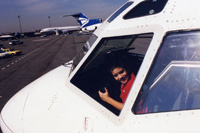 The remainder of my senior year of high school, involved a program called “Senior Seminar.” A class where each student enrolls him/herself in an internship; I choose flight training to become a pilot. To receive my flight training I attended a local flight school at Essex County Airport (Caldwell). I enrolled in a Part 141 training program to ultimately receive a private pilots certificate. I started out learning the basics during ground school, which was one-on-one with my flight instructor. I preferred this method over large classes, because it offers the student a better understanding of the material. In addition, my school had a full video library available to its students for training purposes, to reinforce each lesson. I highly recommend these videos from Jeppesen and King Schools to better any pilot during flight training. Throughout the course I learned many operations, maneuvers, and gained a knowledge about the aviation world. Overall I was loving every minute of it!