Greetings All,
After my final evening in Rome, I woke up very early the next day and caught a shuttle with a few other study abroad students to the airport. We arrived roughly four hours before my flight was scheduled to board. I figured it would be alright if I showed up that early because I could just go through security and then hang out at an empty gate. However, I was informed by a baggage agent that KLM, the airlines I was flying with, only opens for boarding three hours before departure. Therefore, I sat on the tile floor outside security and tried to find ways to entertain myself. Eventually, the security checkpoint was opened and I was able to get in front of a whole tour bus load of people. When I got through security, I bought a snack consisting of a Panini and gummy bears. I then relaxed at my gate until my airplane was ready to board.
My trip back home was a little hectic. My flight into Minnesota was delayed due to a storm. Once we were able to land at the airport, we found out that most of the connecting flights had been grounded due to high wind speeds. At one point, the airport staff made an announcement asking all passengers to please stay away from the windows because the winds were strong enough to either break them or throw an object into the glass. Naturally, people went closer to the windows to watch the storm and take pictures. The plane I caught out of Minnesota was about two hours and thirty minutes late. Luckily, this was my last connection. I just kept my family aware of what time I would arrive home. They picked me up around 2:30 am at the airport and my luggage made it just fine. When I got home I went straight to bed. I was exhausted after flying the better part of two days.
Home for me is Alaska.

Alaska is the largest state in the United States of America and resides in the top left corner of North America west of Canada. Even though Alaska has a gigantic amount of land, relatively few people live here. According to the 2010 Census, there are slightly more than 701,000 inhabitants. Most of the population is concentrated in the main cities: Juneau, our capital, Anchorage, which is the largest city, Wasilla, and Fairbanks. However, there are still a fair bit of people who live in smaller towns and villages located all over Alaska. An interesting fact about Juneau is that even though the city is our capital, it cannot be reached by car. People who would like to visit Juneau must either fly or take a barge. In addition, the city is close enough to glaciers that locals often go swimming in the runoff waters in the summer.

The state is incredibly diverse. Southeast Alaska receives a lot of rainfall and is considered to be almost like Seattle. The Interior experiences extreme temperature changes. In the winter, I remember temperatures reaching as low as -60 degrees Fahrenheit by the river and in the summer around 90 degrees Fahrenheit. Alaska contains the highest peak in North America, Mount McKinley, or as locals refer to it, Denali. Denali means “the great one” in one of the Athabascan dialects. Athabascans are one of the many groups of native indigenous peoples who live here in the Interior.

I live in Fairbanks, which is also located in the Interior. The Fairbanks North Star Borough, boroughs are our version of counties, has about 32,000 residents. While the city is considered small compared to other metropolises in the United States, we have everything we need. We have grocery stores, schools, the University of Alaska Fairbanks, a mall, a movie theatre, golf courses, boutique shops, local markets, restaurants, many stores, and even a few farms. It’s like an oasis because the closest town, Nenana, is about an hour away by car and is very small. The closest big city is Anchorage, which about six hours away. One of the advantages to living in Fairbanks is that Moose Mountain Ski Resort is just outside of town. In the winter, I often meet friends on the hill to go snowboarding.

Even though Alaska has modern amenities, people still live very close to nature. Some college students choose to live in “dry cabins” because they are very inexpensive. These cabins can be a ways out of town and do not have running water or electricity. Wood stoves are used for heat and water is hauled in by truck. Personally, I live in a subdivision a few miles out of town.

Though Alaska is very beautiful and modern, there is always one thing to keep in mind: If you don’t know what you’re doing, Alaska can kill you. If you know what you are doing, Alaska can still kill you. In the winter, roads become slick with layers of ice and snow and temperatures drop so low that without proper attire, hypothermia sets in within a matter of minutes.

Two common misconceptions about Alaska are: that it is always winter and that there is nothing to do. While our summer is short, Alaska does experience about three months of the season. Two seasons that we experience very briefly are fall and spring. Each lasts only a few weeks. Furthermore, there are plenty of outdoor activities to do, such as canoeing, rock climbing, hiking, biking, or having bonfires. In the past, I have gone to laser tag, soccer and hockey games, and various street fairs. For a more historical view of my state, there are always the gold dredges, gold mines, saloons, and national parks. Since cities are so isolated from each other, they often are very self-sufficient and are full of entertainment. This, in combination with the natural beauty of the land, makes Alaska a very popular tourist destination, it most definitely a place to visit if you are ever in the area.
Thank you for reading.

On the way to the restaurant, we passed a number of historical sites, such as The Fountain of Four Rivers.
Located in Piazza Navona, the work of art was designed by Gian Lorenzo Bernini in 1651 for Pope Innocent X. Bernini’s work symbolizes the four rivers, the Nile, Danube, Ganges, and Platte, whose continents, Europe, Asia, Africa, and the Americas, throughout which the papal authority had spread. The papal symbol, the two crossed keys, with the crest of the pope can be seen over the arch of the fountain. On top of the combination of architecture and sculpture, there is an Egyptian obelisk.
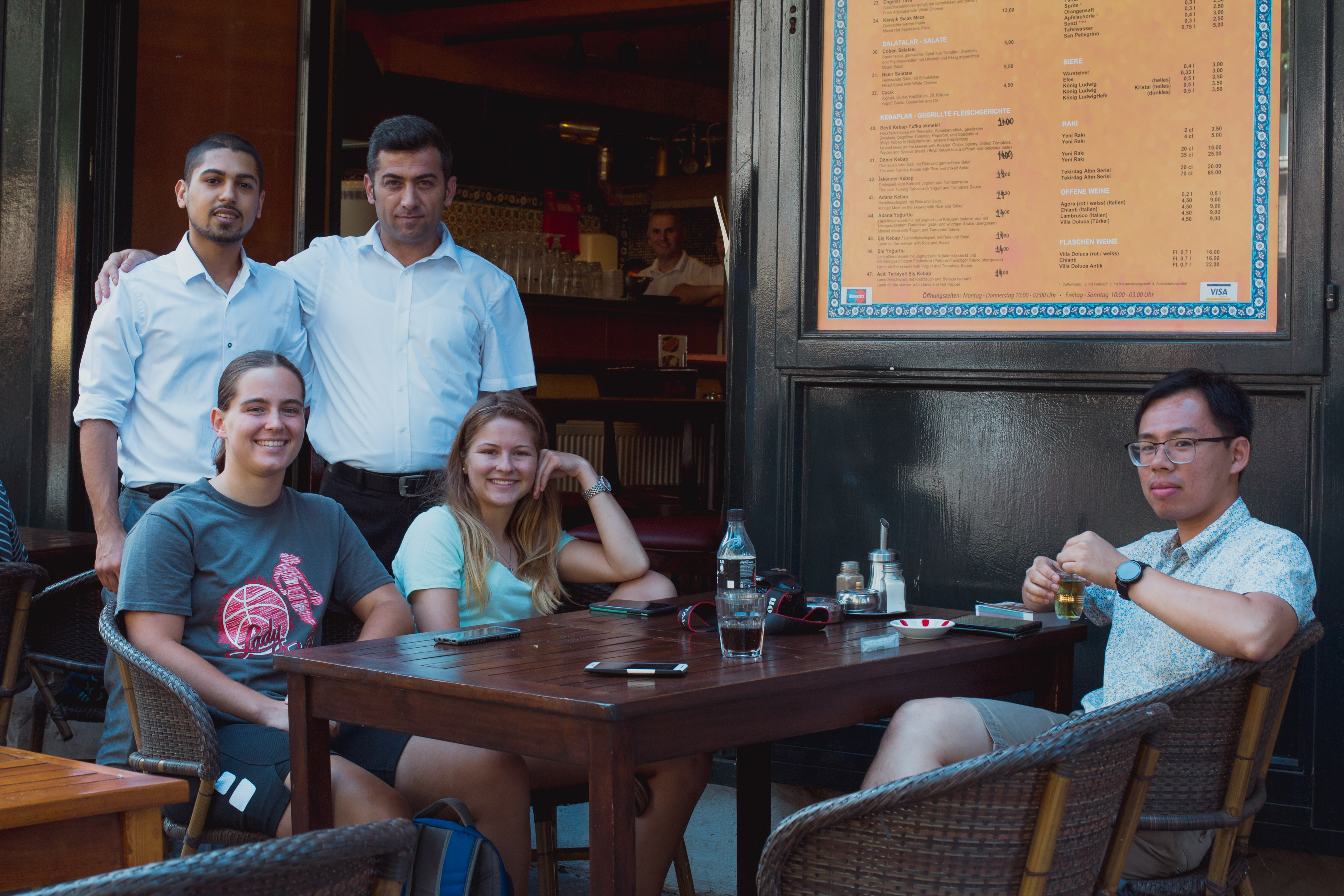
We ate dinner at a small restaurant with outdoor seating. I splurged and ordered a pasta alla carbonara. The dish was made up of pasta, egg, cheese, and bacon. Everybody agreed it was one of the best dishes of the night. While we were waiting for our meal, we took the opportunity to smile for a few photos.
Even though Candace is a few years older than me we got along great. She’s from the ERAU campus in Prescott, Arizona and just graduated with a bachelor’s degree in electrical engineering. Candace is pretty funny and we like a lot of the same things. I was fortunate that she chose to room with me. Oh, and before I forget, the alien antenna is courtesy of Charles. He has a crazy sense of humor, but can also be very pragmatic. Currently he’s studying aeronautical science at the Daytona Beach campus.
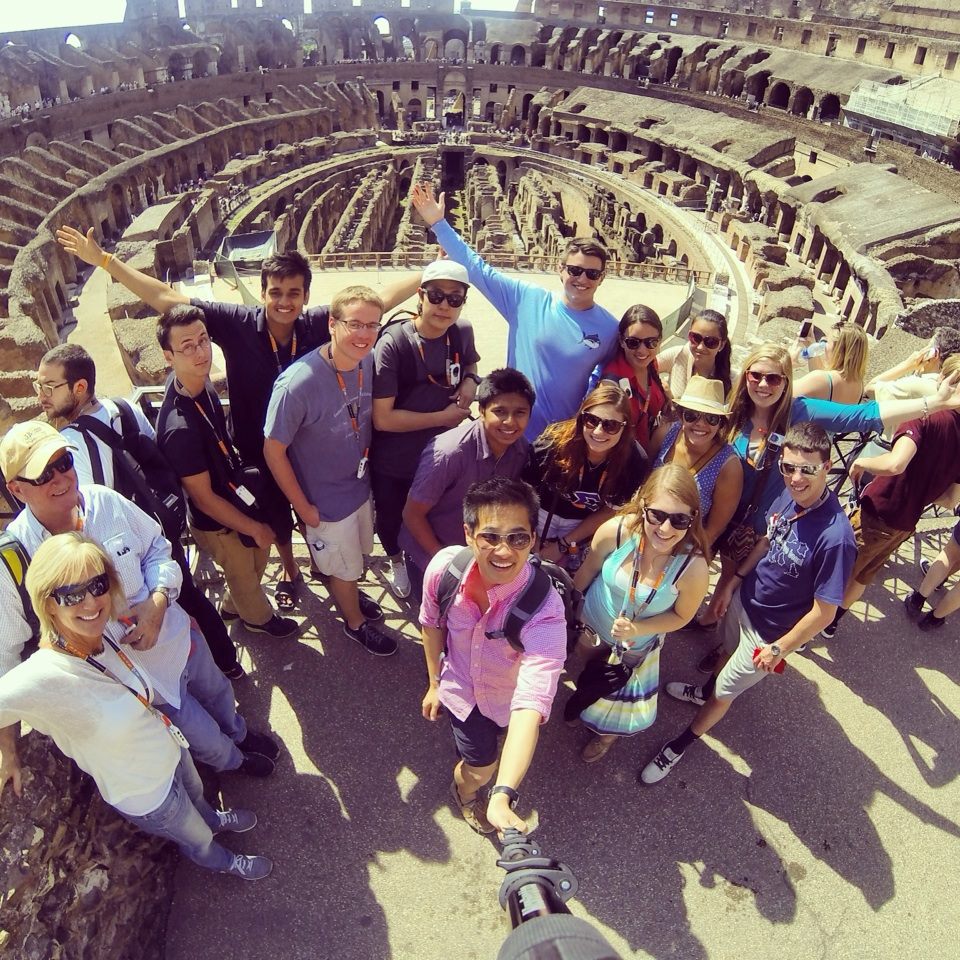
The next morning we started out bright and early. The first ancient building that we visited was the Colosseum.
animals, in these public entertainments were housed in the hypogeum, a series of tunnels and cages underneath the floor of the main arena. In addition, there also used to be underground passages that connected the Colosseum to Ludus Magnus, a school where gladiators trained.


Eventually, we reached the Vatican. Vatican City is the smallest independent state in the world. It is here that the Pope, Pope Benedict XVI, lives. He is not only the Bishop of Rome, but also the head of the Catholic Church. One of the main entrances into the Vatican is St. Peter’s Square.
did not allow pictures. We saw Raphael’s School of Athens, which is a fresco depicting almost every great Greek philosopher. We were also able to visit the Sistine Chapel and see Michelangelo’s famous fresco on the ceiling. One of the many stories featured in the work of art is the story of Adam and Eve. The panel illustrating The Creation of Adam shows God reaching out to touch fingers with Adam. God appears to be reaching out of a human brain to perform this action, displaying Michelangelo’s knowledge of human anatomy. This gives evidence to the thought that the great Renaissance artist performed human autopsies even though they were illegal at the time.
After spending hours in the Vatican Museum, and getting lost multiple times, we exited the building and entered St. Peter’s Basilica.
Following our visit to the Vatican, we returned to the refurbished monastery and recovered from the twelve hours of walking and incredible heat and humidity. While resting in my room, I contacted my friend John who is stationed in Naples with the Navy. I first met John four years ago on a People to People trip to the United Kingdom and Ireland. We kept in contact over the years and he was ecstatic to find out that I would be in Italy. He decided to come and visit while I was in Rome. That evening, a group of my fellow students and I met John and his friend at the Rome Hard Rock Café. We ate and talked the night away. After saying goodbye to John and leaving the restaurant, we decided to use the Roman metro system because we thought it would be an easier way to get back to the monastery. Unfortunately, certain subway lines only run until about 10 PM. While we’re not exactly sure how, we ended up on the back side of the Vatican, which was off our map. Eventually after walking around for about an hour to an hour and a half, we found our way back to the residence.
During the morning of our last day in Rome, the first place we visited was the Baths of Diocletian.
The last tourist attraction we visited as a group with our professors was the Spanish Steps.

In the past, people used this decoration as a tool to tell then when important seasons and holidays were occuring based on the location of the shadows cast by the pins on the chart. In additon, Basilica of Santa Maria Novella is the first church to have volutes, or scrolls, located on either side of the pediment. These s-shaped decorations can be found on churches all over Italy and later were an important feature of Baroque architecture.
While we walked around Florence, we saw multiple busts of Galileo.
next destination was Lorenzo Ghiberti’s Gates of Paradise.
he Old Testament.
attraction in Florence was two hours. Around midday, we entered the Uffizi Museum.


Before I get started about my travels to Siena, Italy and my experiences, I have one order of business to take care of. My previous entry mentioned Steven Bohlemann, a student who works in the Study Abroad Office, but I was not able to get a picture of him in time before I turned the journal admission. As promised, here is a picture of Steven (courtesy of the Study Abroad Office in Daytona Beach).
The most nerve wracking event I experienced was when my train was fifteen minutes late. When this occurs, passengers neither know when exactly their train will arrive, nor do they know the platform, or binario, where their train will be located. To make matters worse, I only had a fifteen minute layover between trains in Chiusi Chianciano. Luckily, my delay did not cause me to miss my second train to Siena. After I arrived at the train station, I took a taxi cab to the Residenza San Domenico, the place where students are housed.
The rooms at Residenza San Domenico are decently furnished. Rooms can house anywhere from two to four students depending on the room. My roommate is a girl from Prescott, Daytona’s sister campus, named Candace. We get along great. No two rooms are alike, but each has a bathroom with a large wardrobe that contains a small kitchenette unit that houses a large sink and hotplate. In addition, silverware, dishes, and cups are provided with the rooms. Some rooms have lofts and others will have large closets and drawers. One of the rooms meant for students has a phenomenal view of neighborhoods across the valley as well as the Duomo, a large gothic church located on of the other hills of Siena.
According to the legend, Romulus, the found of Rome, had two sons, Senius and Aschius. It was these two men who founded Siena. Their colors, white and black, are displayed on the flag of the city and in the colors of the Duomo. On one side, there is an outcropping of red brick and a black and white marble wall. According to my professors, the church was supposed to be much larger than it is today. Work on the expansion halted when Siena was struck by the bubonic plague, which killed about two thirds of the population. I walk by the Duomo every day on the way to class.
The other class is run by Embry-Riddle. At 9 AM, I take an Italian language class with Massimiliano, an Italian professor. Our learning consists of using a text and workbook along with supplementary lessors. We have learned a lot so far. Typically we have a short 30 minute break at 11AM. This is when most students eat lunch. At 11:30, we either have Massimiliano again or we study Italian culture under Dr. Luca Bonomi, the director of Dante Alighieri. When we have Luca, we usually have a short presentation in class and then he takes us outdoors to walk around and explore Siena. We have visited the Piazza del Campo, which is the city center, as well as the main political buildings. One day, we even analyzed Italian body language and what each of the subtle nuances mean. It was fascinating. After either another session with Massimiliano or Luca, we get another short break of about 15 minutes or so at 1:30 PM. Then we are taught by ERAU professors Dr. Alan Pratt or Dr. Robert Fleck. Dr. Pratt teaches art history, which occurs during the first two weeks of our session. He tries very hard to make sure that we are getting the most out of our studies with daily quizzes that require one word answer and consists of about 15 questions. After Dr. Pratt leaves, we study under Dr. Fleck who teaches Italian contributions to both art and science. Professor Fleck is a high energy teacher. It is quite evident that he is passionate about science. One day, he even tried to draw the solar system on the classroom floor while jumping about in an Einstein t-shirt. He is very entertaining. The end of our day can occur as early as 2:30 PM and as late as 4 PM. It just depends on the day. Luckily, we get three day weekends.
During my first weekend in Siena, while I was walking around with my friend Nathan, I saw an old car race.


I initially heard of the organization during the fall activities fair that took place near the beginning of first semester. Steven Bohlemann, a student who works in the Study Abroad Office, had a table set up with pictures, posters, and flyers. He was the one who suggested that I look online at the
After entering, climb the stairs and look for a plain wooden door almost directly across the room from the staircase. Go through the door and proceed down the hallway until there is a branch to the right that has a sign reading “Study Abroad”.
Furthermore, since I am in the Honors Program, Study Abroad also satisfies my HON 350 requirement. I was elated to find out that not only was I able to make my semester course load lighter and more manageable, but studying abroad cost less that attending Summer A on campus at ERAU. I found out this information and other helpful factoids when I attended Study Abroad meetings.
on, I went through my suitcase yet another time to minimize the weight. This will make it easier to travel in Europe, where I will have to haul my own luggage multiple city blocks to get to my destination, Residenza San Domenico. At the end of this week, I will wake up at 4:30am and board an airplane to Houston. The first of three flights to Italy!
After taking the train out of Munich, we arrived in the small town of Traben-Trarbach around lunch on the 13th. We dropped off our things at the quaint little hotel, and headed up to Mont Royal for our glider flights! I was a little nervous about being shot up in the air, and I let a lot of people go before me. However I finally gathered my courage, put on my parachute, and climbed into the glider. The take off was pretty intense, but it was a beautiful view and definitely a fun ride!!! I am very glad to have done this, and I definitely believe this was one of the highlights of the trip. You can check out the video of my take off from the airfield at 
On Friday we flew from Paris to Munich to begin the Germany section of the trip. The flights had been booked for us, and we got to take Air Berlin (check out the picture). I was very impressed by this low-cost European carrier, and will certainly fly them any time I can in the future. Upon arrival, we got checked into our hostel and only had a few hours remaining in the day. A few friends and I headed straight for the city center of Munich, known as Marienplatz. It was definitely the liveliest area in the city, and had a lot of things to see and do. After a nice dinner we headed back to our comfortable room to get prepared for the next day.
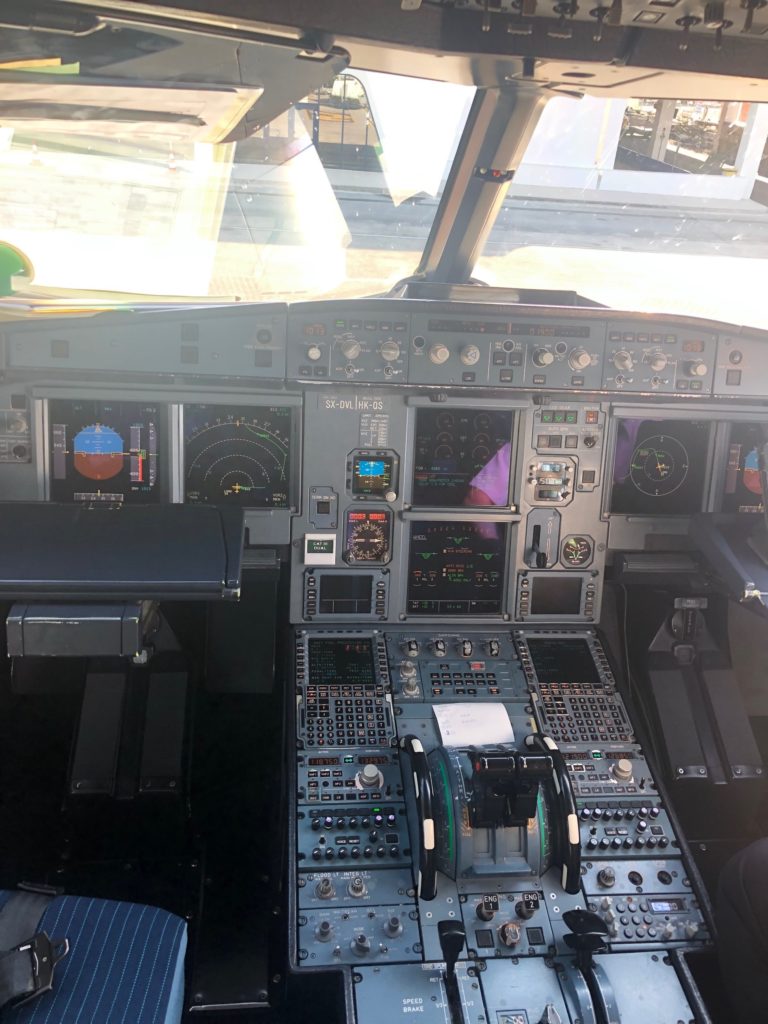
Saturday afternoon, we headed back into central Munich to the main Deutches Museum building, which included airplanes but had also many other displays. At this museum, we got to see many different military aircraft from Germany. Also, there was a Lufthansa Boeing 707 cockpit that you could see into. It is very cool to notice the huge differences in cockpits from many years ago when compared to cockpits of today. Another interesting display was the section on German air traffic control. Aside from the aviation part of the museum, we were encouraged to stay after the session and check out the rest of the exhibits. This museum was certainly one of my favorites and housed exhibits on nearly any technological advancement you could imagine. Some things covered were aviation, space exploration, boating and navigation, nuclear energy, computers, assembly lines, robotics, and thousands of other items. The never-ending array of information was fascinating, and I could have spent a much longer time at the Deutches Museum.
After a long Saturday of work, we were rewarded with a free day to end the weekend. I started my day on a free walking tour and saw a lot of the city. Some of the better sites included the Hofbrahaus, Glockenspiel, Frauenkirche, Mozart’s temporary home, and the City Hall. Although those sites were quite breathtaking, they didn’t even compare to what I was about to experience. That afternoon I hopped on a train and decided to visit the Dachau Concentration Camp outside of Munich. From the moment I arrived I felt the power of such a devastating place. The barracks, the showers, the washrooms, and the museum were almost too much to handle. And then, when I thought I had seen it all, we stepped into the gas chamber and crematorium. The entire time I visited the site I couldn’t help but feel saddened by certainly one of the low points of the human race. However, it was quite a sobering experience, and I certainly will never forget how I felt and what I saw at Dachau.
Munich has been a great way to begin our visit in Germany. I have really enjoyed the city’s liveliness and culture. The German language is very different, but I am having fun trying to use some of what I learned prior to leaving. I am excited to head out to Traben-Trarbach, where our group will take a glider flight. I hope you have enjoyed my Europe journals, and if you have any questions about the trip or something else, email me at
After the fast train ride we checked into our hotel and headed to the Louvre for a group cultural experience. The Louvre displays sucha wide variety of works of art from all different time periods andplaces all over the world. It’s a bit overwhelming to try to grip theimportance and historical value of everything you see. A few of thethousands exhibits included Michelangelo’s Dying Slave and Da Vinci’s Mona Lisa. I really appreciate the effort of Professor Kirton to make the cultural events part of the course. Not only have I learned a lot about aviation, but also I have broadened my global thinking.
Thursday was our free day at Paris, and we accomplished a lot. A group of five of us visited Notre Dame, the Sacre Couer, Centre Pompidou, and the top of the Eiffel Tower. Each attraction was a little different, but I found all of them very interesting. Although they are quite close geographically, the cities of Paris and London feel worlds apart. I love both of them, but I still believe London ranks higher for me. Tomorrow however, we are switching it up again as we fly to Munich to begin our German section of the trip.
The afternoon of our arrival (July 2), we all met at the British Science Museum for our first session. The museum has a great display of all different types of aircraft and parts. One of the most interesting planes was the Vickers Vimy (pictured), which was the first plane to cross the Atlantic Ocean. It was a larger plane for its day, and had some pretty impressive specifications. My other favorite display was a cross section cut out of a British Airways 747 jet. It interested me greatly to see all of the inner workings of the commercial aircraft. The next day (July 3), we headed off to the Imperial War Museum north of London. The train and bus rides to Duxford took a little while, but the wait was well worth it. My true love of aviation is in commercial aviation, and this museum had many commercial displays. I really enjoyed the British Oversees Airways Corporation (BOAC) BAC-VC10. I had never heard or read too much about this aircraft, but it was much bulkier than I expected it to be from pictures. It was like an MD82 on steroids with two extra engines. It was very different looking, but still very cool. Another plane I was surprised to see in Duxford was the Concorde.
(Check out the picture of me by the Concord landing gear!) The exact Concorde at the Museum was never used commercially, but was one of the testing planes used by the production company. In its testing it had set the record speed and the record transatlantic flight time for all the Concords. Also in this museum was a de Havilland Comet 4, B52 bomber, and tons of other really neat planes. The Imperial War Museum was definitely my favorite in England. Saturday (July 4) came and we were off to the Royal Air Force Museum in Hendon. Although military aviation interests me less, it was still top-notch. The displays in the museum were very interactive and held tons of good information. A lot of information was always appreciated as part of our work included filling out information sheets on aircraft and how they affected aviation and the world. With the information sheets completed we would gather and do short presentations on our favorite planes. This was an effective and simple way to grasp an understanding of how important these planes were to their country’s development and protection.